
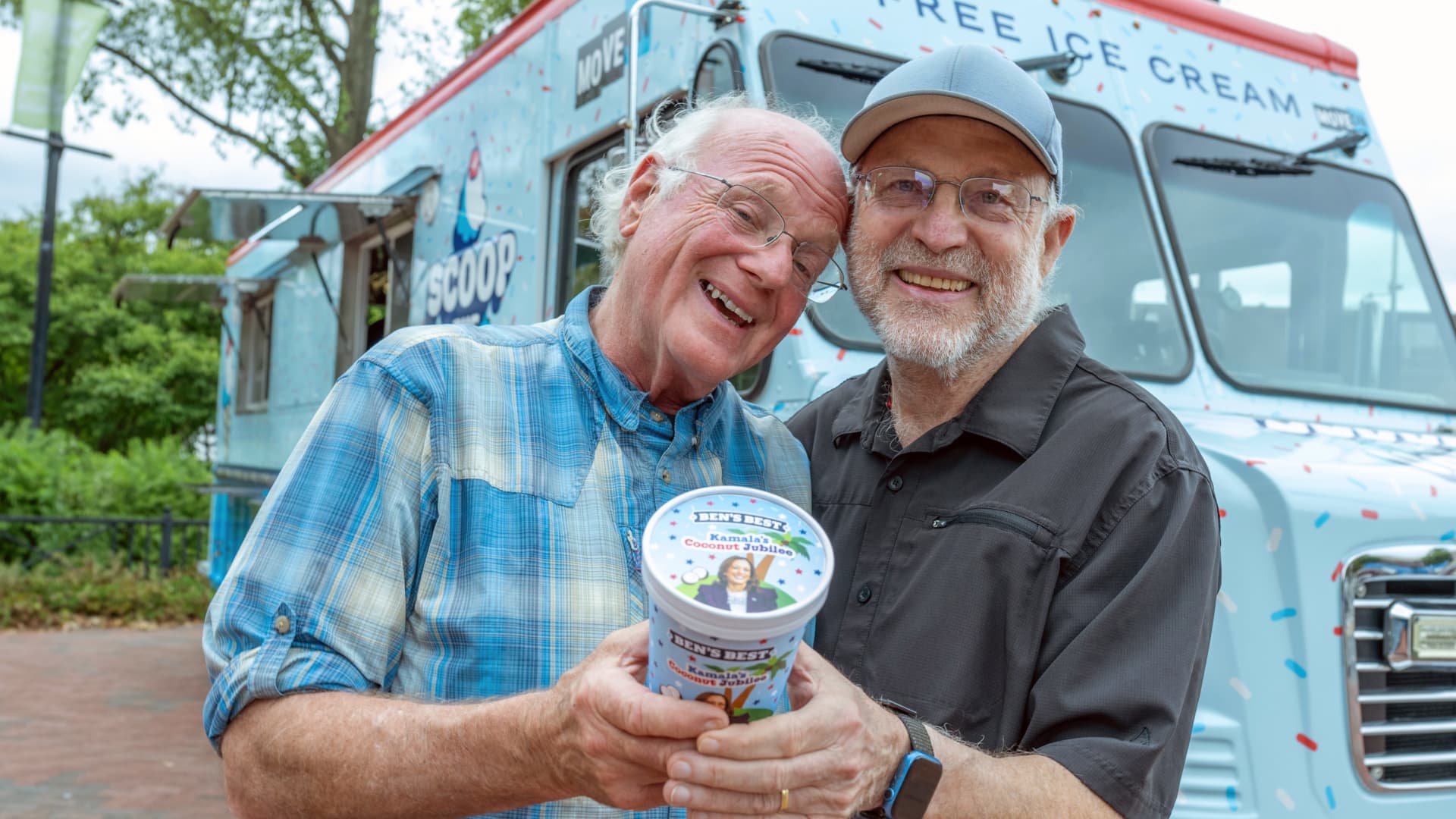

Ben Cohen, co-founder of Ben & Jerry’s, criticized parent company Magnum Ice Cream, declaring it is “ruining” the brand in a conversation with CNBC.
The largest independent ice cream operation, Magnum, is barely a week old but has already seen considerable corporate upheaval.
Ben & Jerry’s CEO Jochanan Senf, appointed by Unilever, stated that modifications to board terms, such as a nine-year limit, establishing a board schedule with “engagement protocols,” and a requirement to adhere to Magnum’s business integrity guidelines, would bolster governance and clarity.
Cohen, however, termed it “Orwellian.”
“They claim they’re enhancing the social mission when they are genuinely dismantling it. They assert they’re future-proofing the Board of Directors while they are truly breaking it apart,” Cohen relayed to CNBC. “It’s merely another desperate attempt at gaining authority.”
By Monday, three directors had been removed from the independent board of Ben & Jerry’s, marking a new development in the dispute between the brand named for its renowned founders and its parent organization regarding the brand’s social objective. This conflict was passed down to newly independent Magnum from the consumer giant Unilever when it officially became an independent entity last week.
Ben & Jerry’s recent action to revise its board governance was meant “to maintain and enhance the brand’s foundational social mission and protect its core integrity,” Ben & Jerry’s expressed in a press statement.
Chair Anuradha Mittal — one of the board members informed of their disqualification — was told she “no longer qualifies to serve” as a board member following “internal inquiries,” according to the company, which did not elaborate further.
“At first, they aimed to remove the chair of the [independent] board by making these baseless claims that she’s ‘unfit to serve.’ They couldn’t prove that, so now they’re claiming, well, she served for too lengthy a period,” Cohen stated. “It’s arbitrary, and it’s unlawful.”
Ben & Jerry’s was acquired by Unilever in 2000 in an agreement that allowed the brand to keep an independent board and the authority to make decisions regarding its social mission. However, since 2021, there has been increasing dissatisfaction from the board and founders Cohen and Jerry Greenfield over what they perceive as efforts to “suppress” the social mission.
Unilever, and now Magnum, holds principal responsibility for all issues unrelated to the social mission or expressly allocated to the Ben & Jerry’s board, including financial and operational matters.
CNBC has reached out to Magnum and Unilever for feedback. Unilever has indicated that the social mission of Ben & Jerry’s has diverged from what was agreed upon in 2000, claiming the company is presenting significant reputational and business dangers.
Not available for sale
Unilever and Magnum have repeatedly asserted that Ben & Jerry’s is not up for sale.
Ben & Jerry’s is one of the four global power brands in the ice cream portfolio, alongside Heartbrand, Magnum, and Cornetto. In 2024, Ben & Jerry’s generated 1.1 billion euros ($1.3 billion) in group revenue, ranking as the third-largest revenue contributor among the group’s assortment of over 100 brands. The four brands collectively accounted for 82% of the group’s overall annual revenue.
Unilever first revealed intentions to separate its ice cream division in March of the previous year. “We needed a real concentration on ice cream,” Magnum CEO Peter ter Kulve stated to CNBC’s Squawk on the Street last week, emphasizing how the company manages to increase both market share and volumes.
Since the pure ice cream stock made its debut on public exchanges in Amsterdam and New York on December 8, the stock has appreciated roughly 10% and is now valued at nearly 9 million euros. The company has established a revenue growth objective of between 3% and 5% by 2026.
However, Cohen, who remains involved with the brand, does not perceive any advantages in the brand he co-founded in 1978 being part of the ice cream group.
“They’re being shortsighted, but I also believe they simply don’t understand,” he remarked regarding management. “They lack comprehension that the value of Ben & Jerry’s is tied to its established position as a leader in businesses that care for the broader welfare of society, not merely focusing on profit maximization.”
“Investors would fare much better if Magnum finally divested this asset, which they are in the midst of depreciating, and instead channeled the funds into acquiring other middle-ground brands, as that’s within their expertise,” he continued. “There is substantial profit potential in the moderate sector, but they ought to stick to what they know and refrain from trying to force Ben & Jerry’s to turn into just another one of their average brands.”
In September, Cohen and Greenfield initiated the #FreeBenAndJerrys campaign, urging their parent company to permit it to operate “as an independently owned enterprise with socially-conscious investors, again free to uphold its social mission and adhere to its brand values, without compromise.”
The initiative aims at motivating a collective of investors who support the social mission to repurchase the brand.
“We have that collective, they’re prepared,” Cohen mentioned, adding that Unilever and now Magnum are unwilling to provide the essential financial details that investors require to make an informed offer. Cohen did not disclose the identities of the investors.
Unilever noted in its third-quarter earnings report that Ben & Jerry’s experienced mid-single-digit growth, bolstered by the ongoing success of recently launched innovations like new dairy, non-dairy flavors, and Scoopapalooza, but did not specify additional financial data on a brand-by-brand basis.
Harmony, love, and ice cream
Ben & Jerry’s has a threefold mission: a social mission, a product mission, and a financial mission, which Cohen argues are all equally crucial and interconnected. “It’s something people raised in the Unilever traditional system struggle to understand. We took considerable time to figure it out… and they’re merely attempting to turn us into another portion of frozen homogenization.”
“There’s no way Ben & Jerry’s can uphold the values that established it as the brand it is today without being owned by a stock of investors that actively support the social mission, rather than trying to undermine it,” Cohen said about the brand that embraces “peace, love, and ice cream” as its tagline.
Magnum CEO Ter Kulve informed the Financial Times earlier this month that Cohen and Greenfield should “pass the reins to a new generation.”
However, Cohen insists that it’s not about him personally, but rather about sustaining the values of the company. “Values don’t age,” he declared.
“I would have no issue handing control over to this group of investors that uphold the values… and if Magnum truly championed the social mission, I’d be fine with them overseeing it.”
