
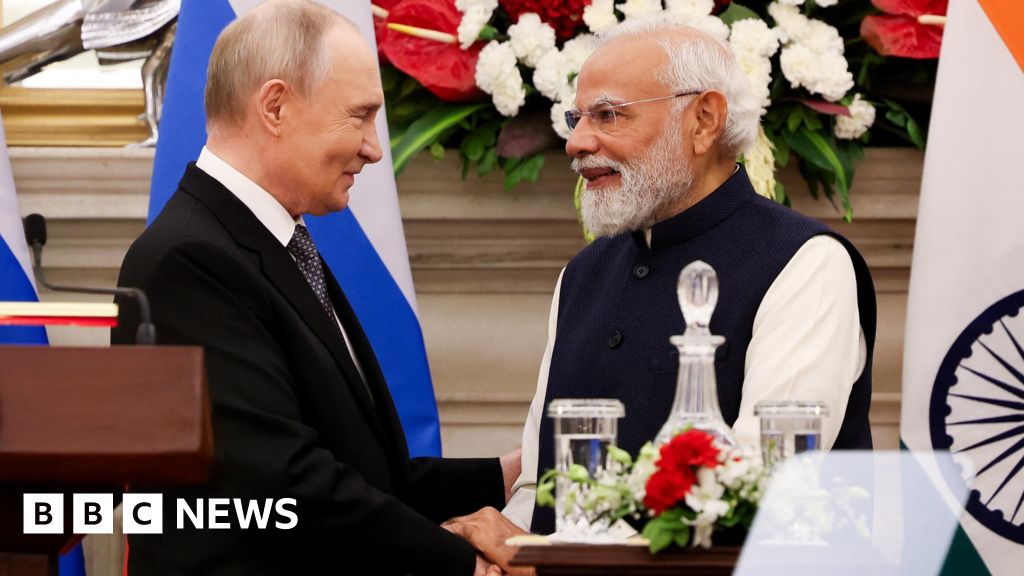
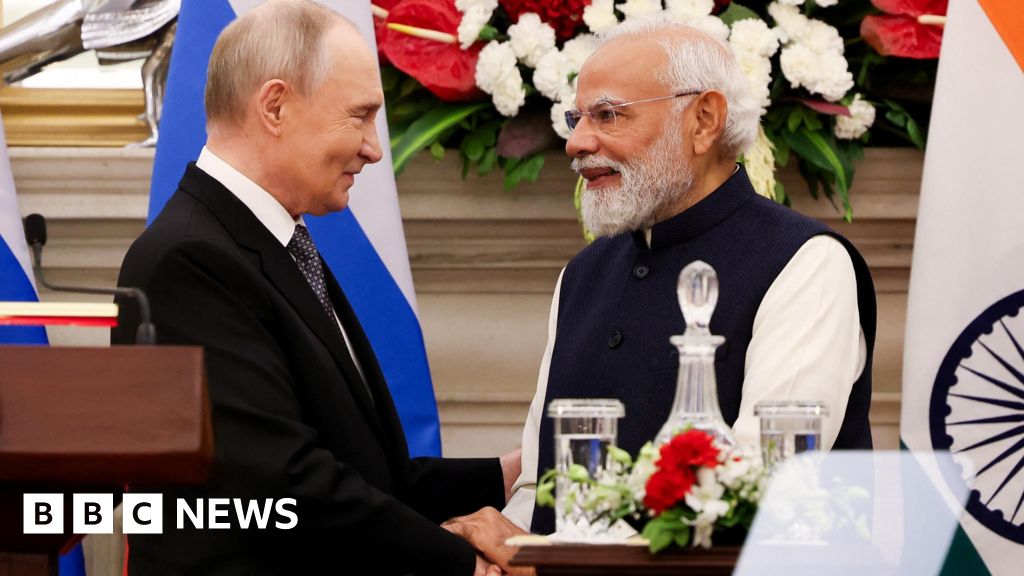
Vladimir Putin, the President of Russia, has announced that Moscow is prepared to ensure “continuous deliveries” of fuel to India, as New Delhi comes under pressure from the United States to cease acquiring Russian oil.
While addressing the media alongside Indian Prime Minister Narendra Modi in Delhi, Putin raised the issue of why India should face repercussions for purchasing oil when the United States itself imports nuclear fuel from Russia.
President Donald Trump has enacted tariffs of 50% on most products from India, contending that India’s ongoing oil purchases from Russia contribute to financing the war in Ukraine – a claim that India refutes.
Putin’s trip occurs as the United States engages in talks with Russia and Ukraine in a bid to negotiate a peace agreement to conclude the conflict.
On Thursday, Putin informed India Today that Russia is pursuing a “peaceful resolution” to end the war – cautioning that Ukraine must retreat from the Donbas or else Russia will take control of it.
“We will either reclaim these regions through force, or Ukrainian forces will abandon these areas,” he stated.
Modi reiterated India’s position that it was not neutral regarding the conflict in Ukraine and aligned with “the side of peace”, appreciating endeavors to secure a “lasting” resolution to halt the war.
He emphasized that enhancing the “connectivity” between Russia and India is a “key priority” for India.
In recent months, the relationship between India and the US has reached an historic low as the two nations have struggled to overcome the tariff impasse.
Trump initially instituted a 25% tariff on Indian goods, subsequently adding another 25% as a penalty for India’s acquisition of Russian oil – a measure that the Indian government labeled as “unfair, unjustified and unreasonable” at that time.
During his interview with India Today, Putin remarked on the US tariffs imposed on India for purchasing Russian oil, stating that India should have the same rights as the US.
“The United States continues to procure nuclear fuel from us for its nuclear power facilities. If the US can buy our fuel, why shouldn’t India enjoy the same right?,” he questioned.
Russia was the leading supplier of nuclear reactor fuel to the US last year, Bloomberg reported in September, citing information from the Department of Energy. In May, a ban on enriched uranium imports from Russia was codified into law.
The two leaders exchanged documents during Friday’s briefing, delineating shared goals in areas like trade and agriculture.
Modi introduced two new 30-day visa initiatives for Russian tourists coming to India and announced the opening of two new Indian consulates in Russia.
Russia Today, a state-controlled TV network backed by the Kremlin, would also be launched in India, noted the prime minister.
While no significant defense agreements were revealed, the two leaders mentioned that accords were signed regarding shipbuilding, investments in civil nuclear energy, and vital minerals.
India and Russia agreed upon an economic plan extending until 2030, covering employment, shipping, and healthcare.
Putin expressed his confidence in boosting the current bilateral trade from $60 billion to $100 billion in the upcoming years.
Modi indicated that “energy security has been a fundamental and significant foundation of the India-Russia partnership”, though he made no concrete reference to oil.
India, recognized as the world’s third-largest crude oil consumer, has been importing substantial quantities from Russia since Moscow’s large-scale invasion of Ukraine in 2022.
However, certain Indian companies have begun to scale back oil imports from Russia to adhere to US sanctions.
Putin further referenced a “flagship initiative”: the construction of India’s most extensive nuclear power station, which he asserted Moscow would assist with.
In a joint statement released post-meeting, the leaders asserted that their collaboration was being “redirected towards joint research and innovation, alongside the development of advanced defense systems”.
Putin noted that he and Modi are partnering on foreign policy, with their coalition of Brics nations advocating for a “fairer” and “multi-polar” global landscape.
Brics is a loose coalition of several leading developing nations – comprising India, Russia, China, Brazil, and South Africa – formed in 2006, primarily to contest the political and economic dominance of North America and Western European countries.
